Spheriz
A circular puzzle game that rethinks falling-block gameplay across a radial 2D board and a fully rotatable 3D globe, with handcrafted levels, progression, online services, and a cosmetic economy.
Architecture
Server-authoritative game services
Player device
React Native client
Expo · Skia · 2D and 3D gameplay
Trust boundary · Authenticated API
Cloudflare Worker
Validation and trusted operations
Managed services
PlayFab
Cloud-backed progression and game state
RevenueCat
Purchases and entitlements
Authoritative economy state
Orb and reward rules are not trusted to the client
What if the familiar falling-block puzzle did not have to be built around a rectangle?
Overview
Spheriz is a puzzle game built around changing one of the fundamental assumptions of falling-block games: the shape of the board. Instead of a rectangular well, Spheriz uses circular geometry.
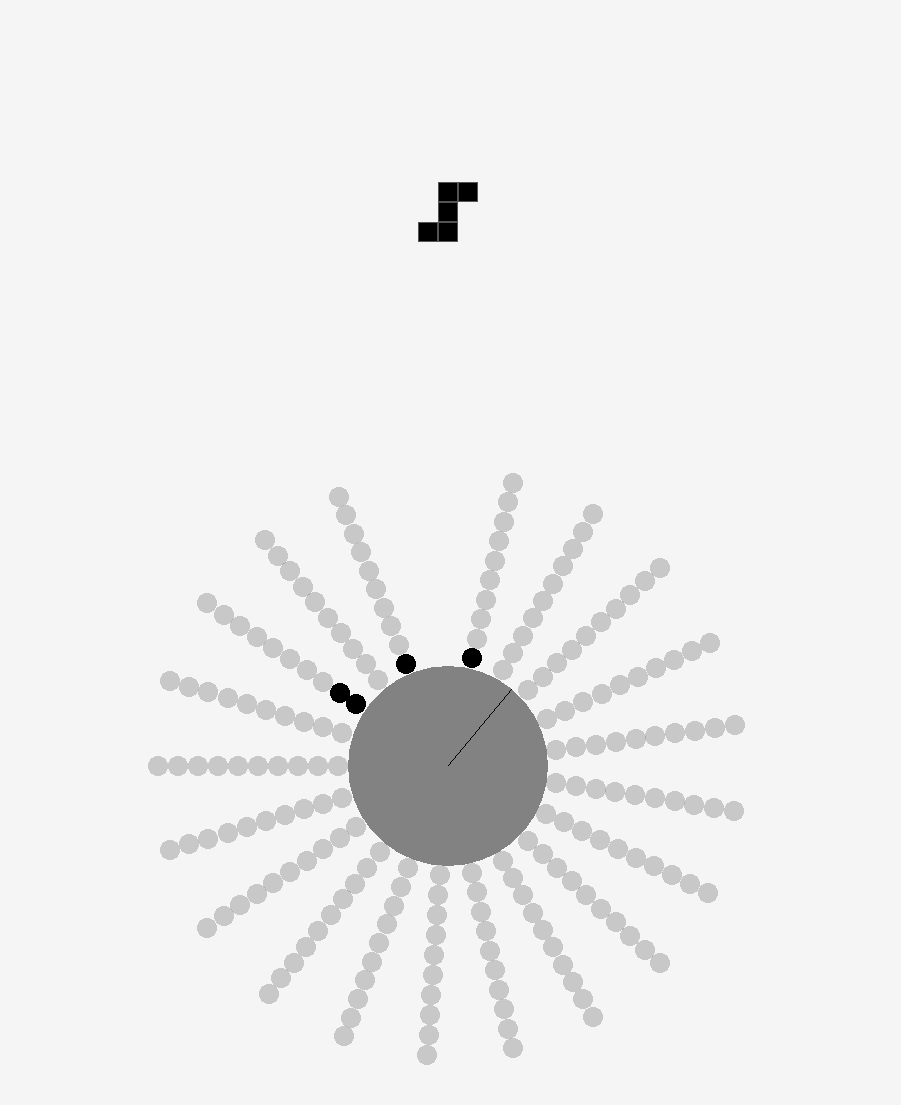
In Classic 2D, pieces enter from the outside and move toward the center. The board is divided into radial sectors and concentric rings, and completing a ring clears it. In Classic Globe, the same idea becomes three-dimensional: the player interacts with a rotatable globe, dragging it to aim, rotating the current piece, and dropping it into place. The globe itself becomes part of the controls.
The goal was to keep the elegance of falling-block puzzles, pieces arrive, rotate, place, complete a structure, clear it, while forcing genuinely different spatial reasoning. Spheriz started more than two years before release as a small C++ experiment.
Two Ways to Play
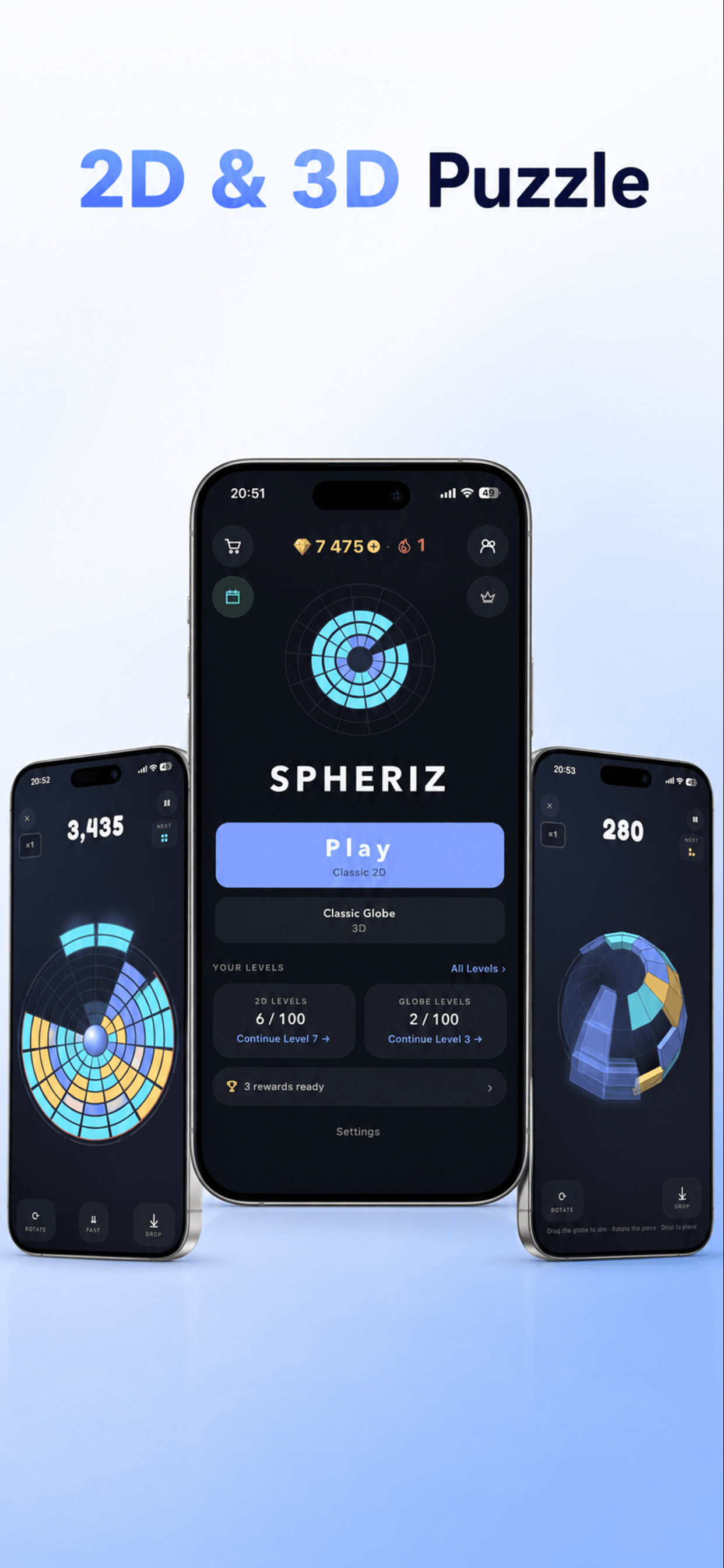
Classic 2D and Classic Globe share the same underlying rules but ask for different spatial thinking.
In Classic 2D, pieces fall inward toward the center of a circular board, and the player rotates and places them into radial sectors. Completing a full ring around the board clears it, opening space closer to the edge.
In Classic Globe, the board wraps around a sphere. The 3D mode is not a cosmetic camera angle: the player has to reason about a surface that wraps around an object, rotating the globe to inspect the far side and choosing where a piece should land before dropping it.
Beyond Endless Mode
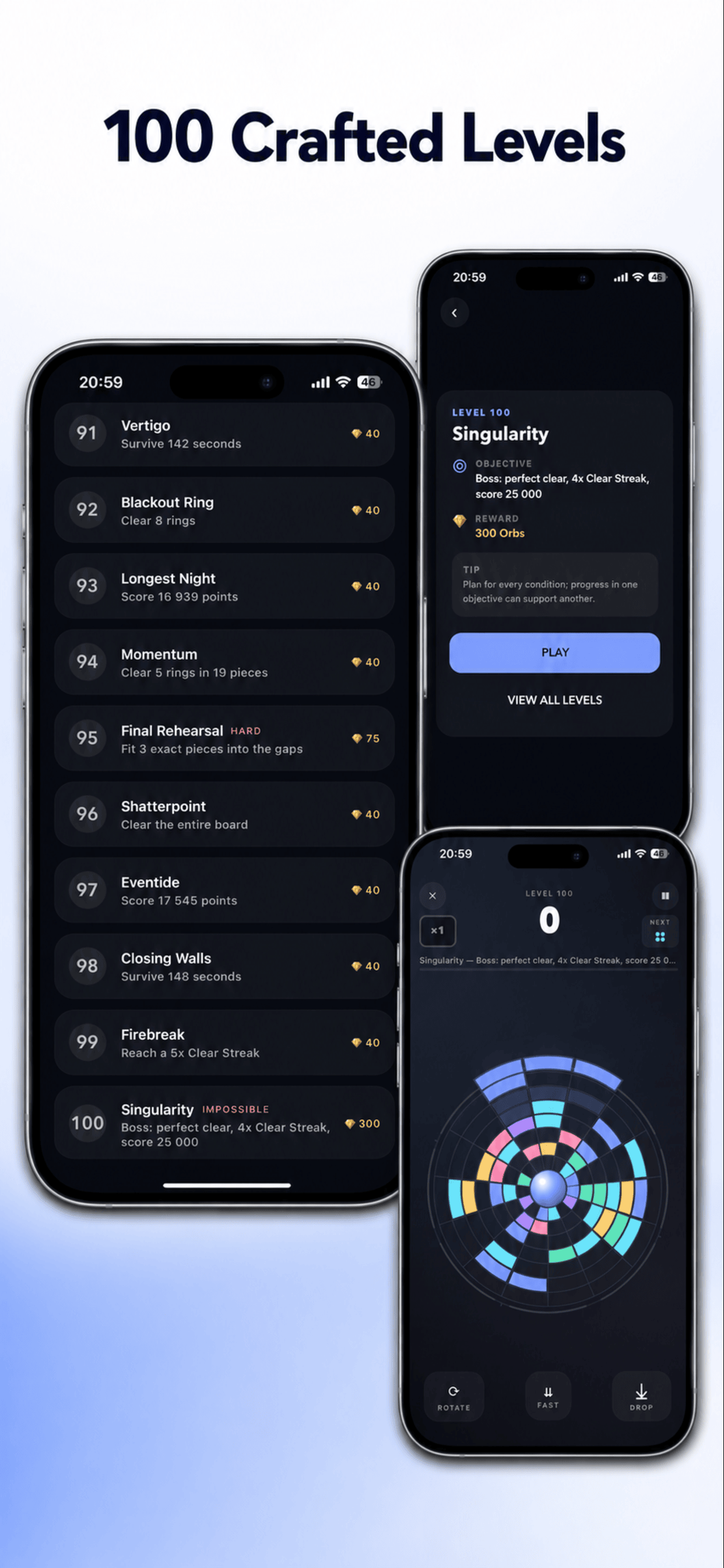
Spheriz has structured campaign levels rather than being only an endless high-score game. Objectives include target scores, survival time, clearing a set number of rings, limited-piece challenges, clear streaks, fitting exact pieces into constrained gaps, and clearing the whole board. Late-game levels combine several of these conditions at once.
Two 100-level campaigns, one for Classic 2D and one for Classic Globe, extend the core mechanics into structured challenges. Level 100, Singularity, is the final challenge in each campaign: a boss-style level that demands a perfect clear, a 4x clear streak, and a score of 25,000 in a single run.
Progression and Customization
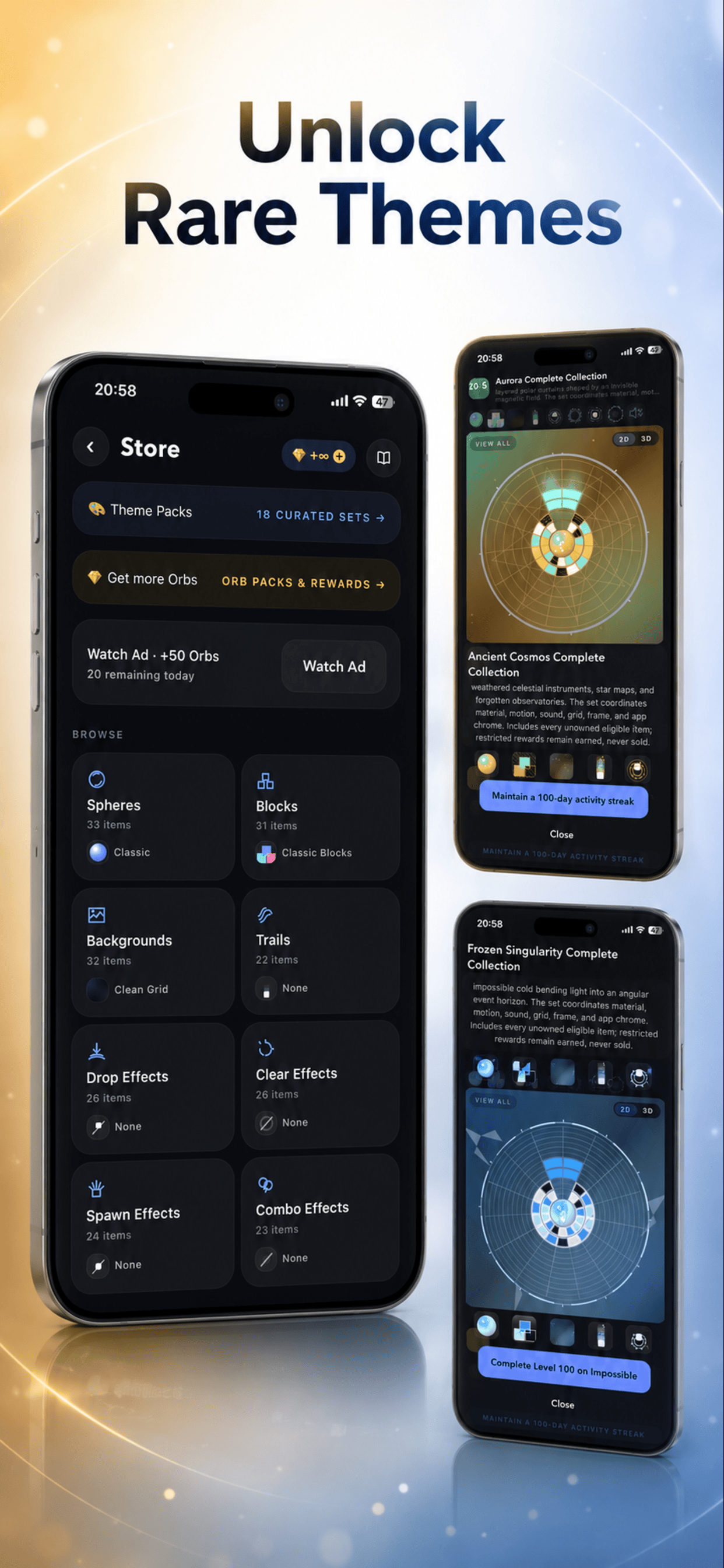
Customization became a major secondary system. Players unlock and equip spheres, block styles, backgrounds, trails, and drop, clear, spawn, and combo effects, with themed collections bundling several of these together into a single curated look. Cosmetics change presentation and identity, not competitive mechanics.
Orbs are the game's progression currency: earned through gameplay and rewards, spent on cosmetics, and optionally available through purchases. Spheriz Premium is a one-time lifetime purchase rather than a subscription. Competitive scores stay based on gameplay, not on what a player has bought.
Building the Infrastructure Behind a Puzzle Game
Taking Spheriz from prototype to production required much more than the gameplay renderer. The finished app needed authentication, cloud-backed progression, achievements, streaks, daily challenges, leaderboards, sensible offline practice behavior, advertising, a one-time Premium purchase, Orb consumable purchases, purchase restoration, account deletion, and cross-device data.
The client is built with React Native, Expo, and TypeScript, with Skia handling the 2D rendering and a custom renderer driving the 3D globe. A Cloudflare Worker sits in front of PlayFab for authenticated backend operations, RevenueCat handles purchases and entitlements, and AdMob serves advertising. Anything tied to the Orb economy is server-authoritative rather than trusted from the client.
Building Something Original From Something Familiar
The mobile stores were full of games built around the same rectangular block-puzzle assumptions. I was interested in whether the underlying falling-block idea still had unexplored territory if the geometry itself changed.
What if the board isn't rectangular? What if there are no horizontal rows? What if space wraps around a center? What if the board itself becomes three-dimensional? Those questions, answered one at a time, are what turned a familiar mechanic into Spheriz.
Shipaton 2026
Spheriz was developed independently, long before RevenueCat's Shipaton 2026 competition existed. Shipaton didn't create Spheriz, but it became an important deadline and motivation to turn a two-year-old experiment into a released product, and Spheriz is being prepared as my Shipaton 2026 entry.
Behind the Project
Read the complete story, from the original C++ experiment to the released game: From a C++ Experiment to Spheriz.
Links
Engineering concepts used
Why You Should Never Trust the Client: Server-Authoritative App Architecture
Use trust boundaries, authorization, validation, idempotency, transactions, and server-owned rules to keep mobile games and APIs correct under tampering and retries.
Designing Retry-Safe APIs with Idempotency
Retries are normal. Idempotency makes important API operations safe to retry without pretending distributed systems can guarantee magic exactly-once execution.
What Happens When Your App Makes an HTTP Request?
Follow fetch through DNS, connection security, edge infrastructure, authentication, cache, database, serialization, retries, and the final UI update.
React Native Performance Visualized: JS Work, Rendering & Dropped Frames
See how JavaScript, React rendering, native/UI work, lists, images, and state updates compete for a frame—and which optimizations actually help.
RevenueCat + Expo: Subscriptions, Lifetime Purchases, and Restore
How to add in-app purchases to an Expo app with RevenueCat: entitlements over product IDs, why restore is mandatory, and why the client is the wrong place to trust a purchase.
Key Highlights
- •Designed an original radial falling-block mechanic with both 2D and fully rotatable 3D implementations
- •Evolved a more-than-two-year-old C++ gameplay experiment into a production mobile game
- •Built two structured 100-level campaigns alongside achievements, daily challenges, leaderboards, and cosmetic progression
- •Designed a server-authoritative economy using Cloudflare Workers, PlayFab, and RevenueCat
- •Shipped the iOS product independently across gameplay, UI/UX, backend infrastructure, monetization, testing, and App Store release