How My Girlfriend Accidentally Gave Me the Idea for PassportPlate
The real story behind PassportPlate: a tired kitchen conversation, a half-joking suggestion to spin a wheel, and how that became an offline recipe app.
I am not a good cook. I can manage breakfast, pasta, eggs, the basics that keep a person alive. My girlfriend, on the other hand, is genuinely the best cook I know. She cooks almost everything in our house, and she's good enough that I've stopped even pretending I could keep up.
You'd think that arrangement solves all our food problems. It doesn't. The hard part was never the cooking. It was the deciding.
"What Do You Want Today?"
Almost every day, she'd ask the same question: "What do you want today?"
And almost every day, I'd give some version of the most useless answer possible: "I don't know." "I don't really care." "I'll eat whatever you make."
Great. Very helpful. My girlfriend, the best cook I know, negotiating dinner with a man whose culinary opinions rival a golden retriever's.
So she started doing what most people do: searching for inspiration. Recipe sites, TikTok, Instagram, Google. At some point she got specifically into recipes from other countries, because cooking something unfamiliar made the whole process more exciting than making the same five meals on rotation.
The Sentence That Started It
Then one evening, half-joking, she said something like: "What if I just spin a wheel with countries?"
That sentence did something to me. I'm a developer. I hear "spin a wheel" and something clicks. Instead of scrolling through thousands of recipes trying to make a decision, why not let randomness make it for you? Remove the choice entirely and just... land somewhere.
I couldn't stop thinking about it that night, and by the next day it had already grown past "a wheel with countries." I wanted it to feel like opening a reward in a game. Not gambling, nothing addictive, just a small burst of anticipation before you find out what's for dinner. The country appears, the recipe loads, and you think, "Huh, I've never cooked anything from Georgia," or "I don't think I've ever made Peruvian food in my life."
It solves decision fatigue by skipping the decision entirely. It nudges you toward cuisines you'd never seek out on your own. Dinner stops being a negotiation and starts feeling a little like traveling, without leaving the kitchen.
Two Ways to Spin
That's the origin story. The part nobody tells you about is everything that happened after the idea felt exciting, and how much the actual mechanic grew past "a wheel with countries."
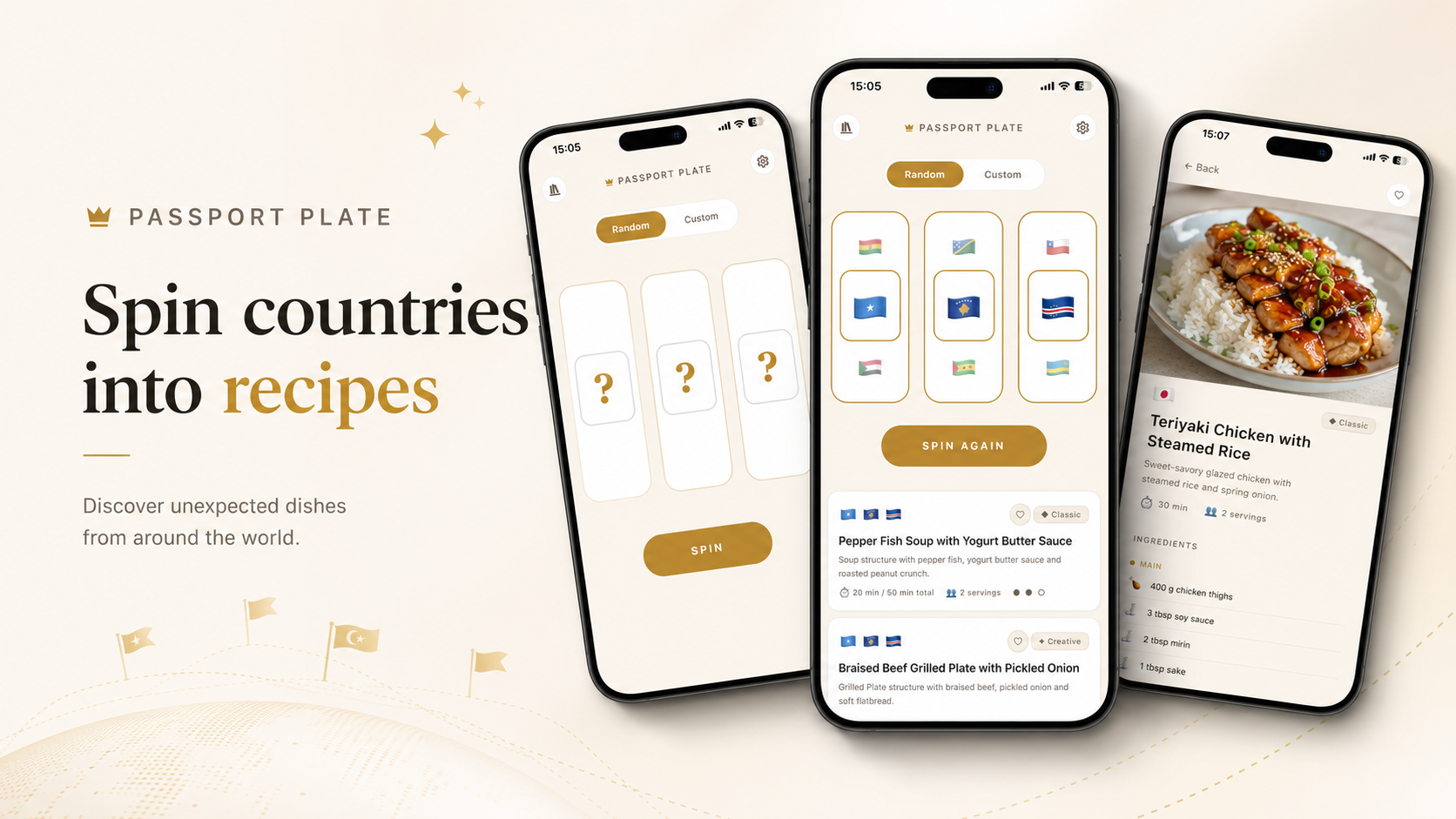
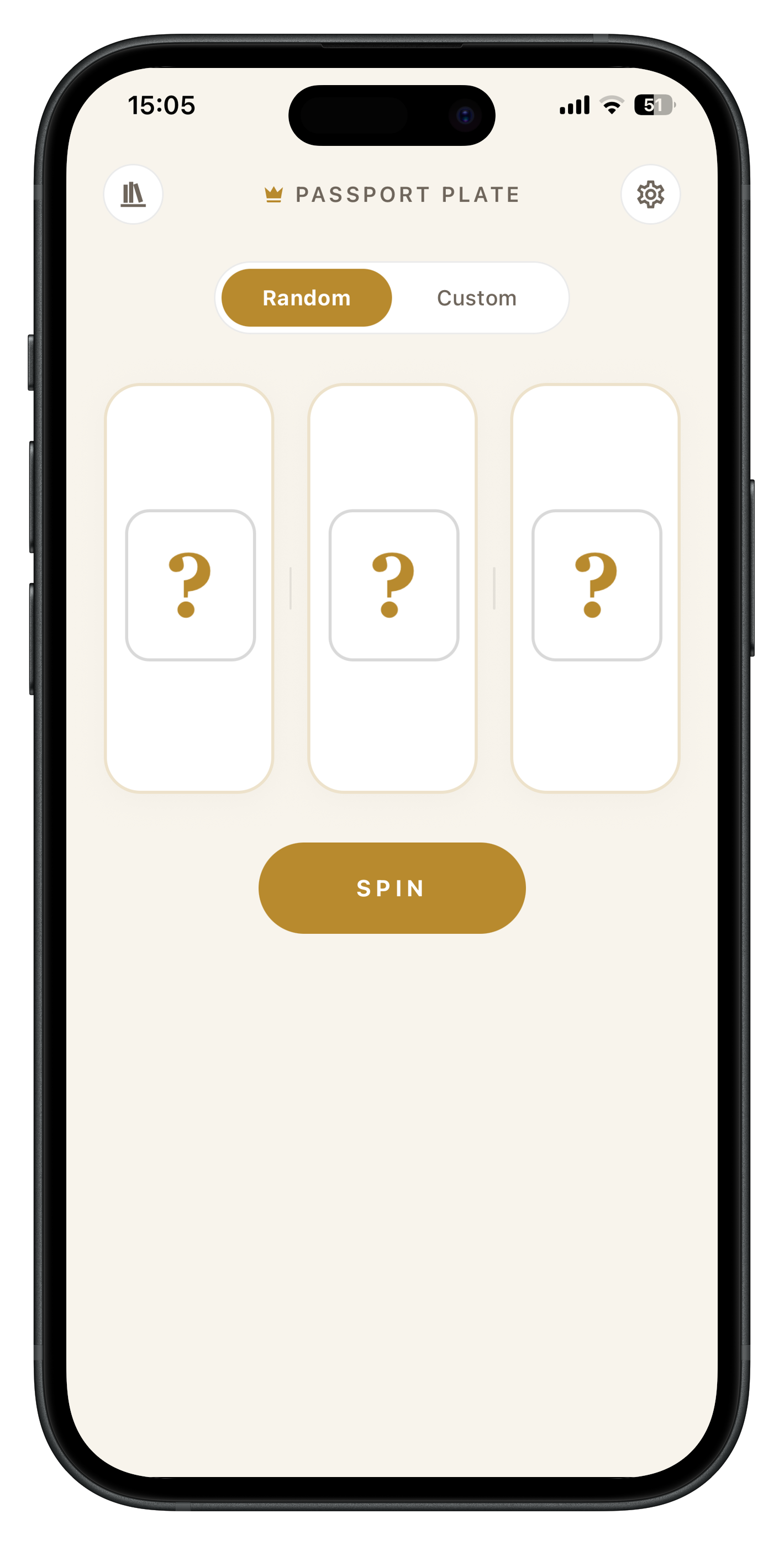
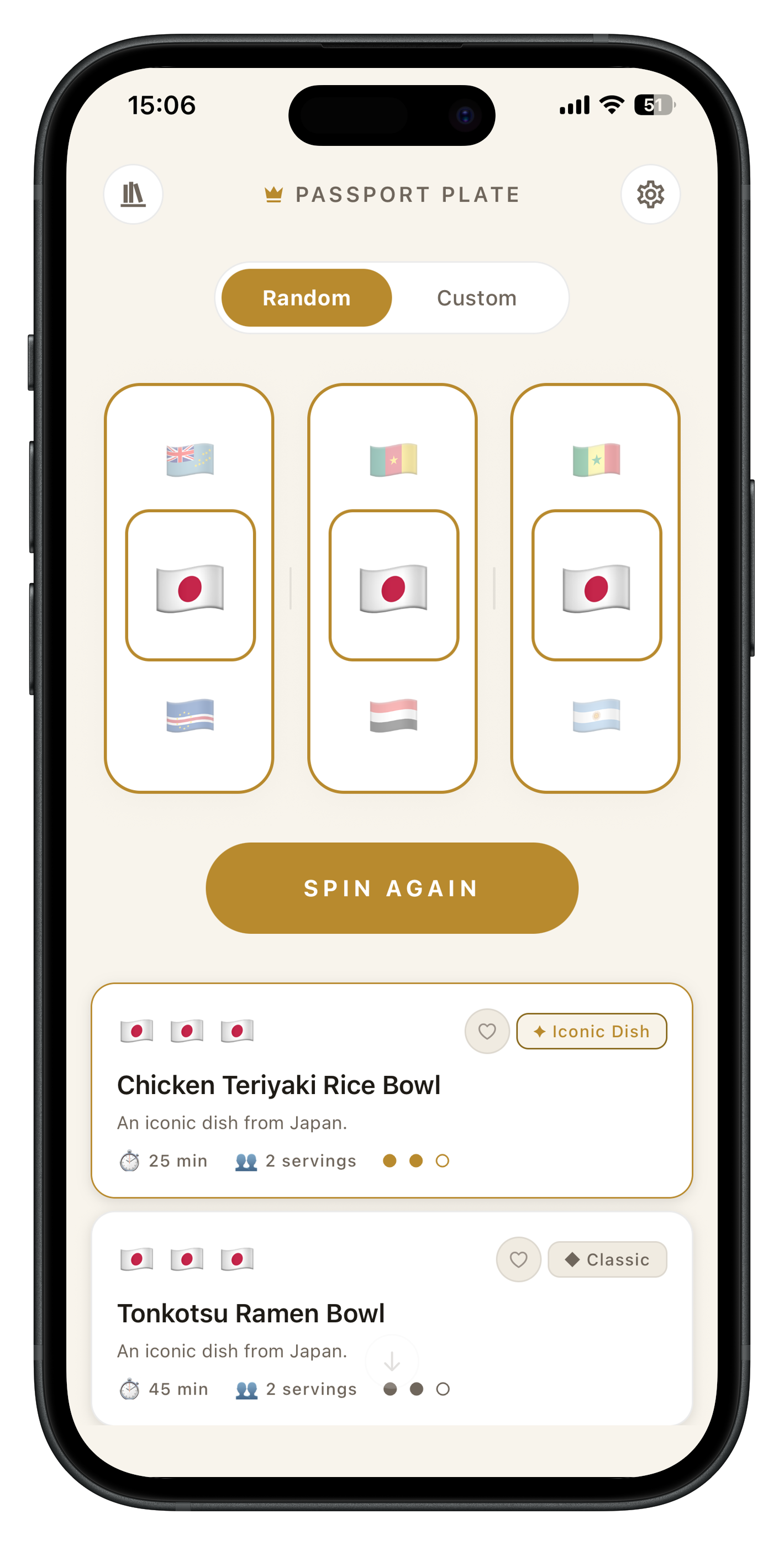
What shipped is a screen with three slots, one for the main dish, one for the sauce, one for a twist, each tied to a country. Random fills all three for you: hit Spin, and three flags settle into place.
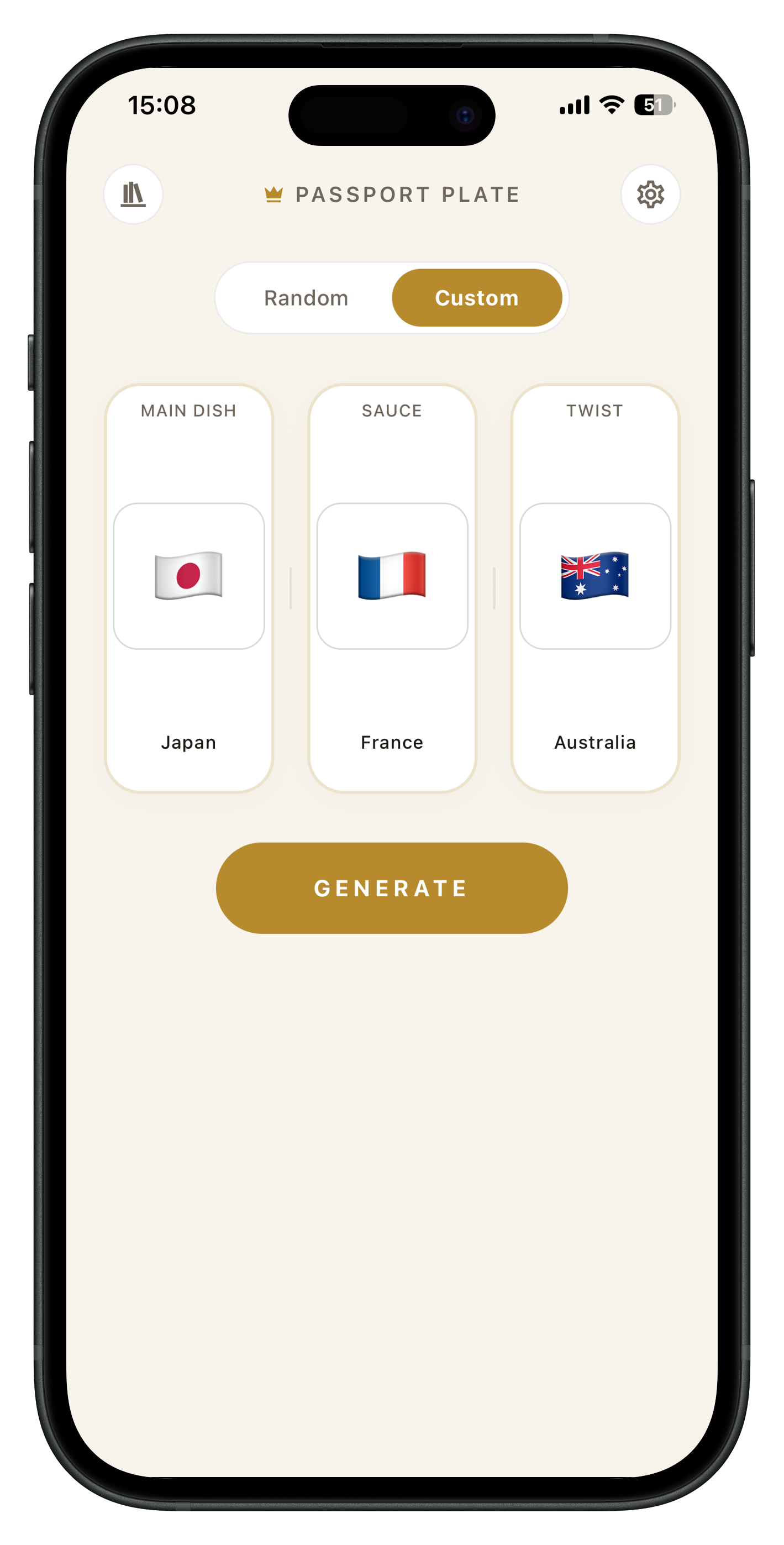
But sometimes randomness isn't actually what you want. Maybe you already know you're in the mood for something Japanese and just want the sauce and the twist to surprise you, or maybe you want full control over all three. That's what Custom mode is for: pick a country for each slot yourself, then generate the recipe from exactly those three.
Classic, Creative, or Iconic
Here's the part I didn't fully see coming until I was deep into building it: what you get back depends on whether the three slots agree with each other.
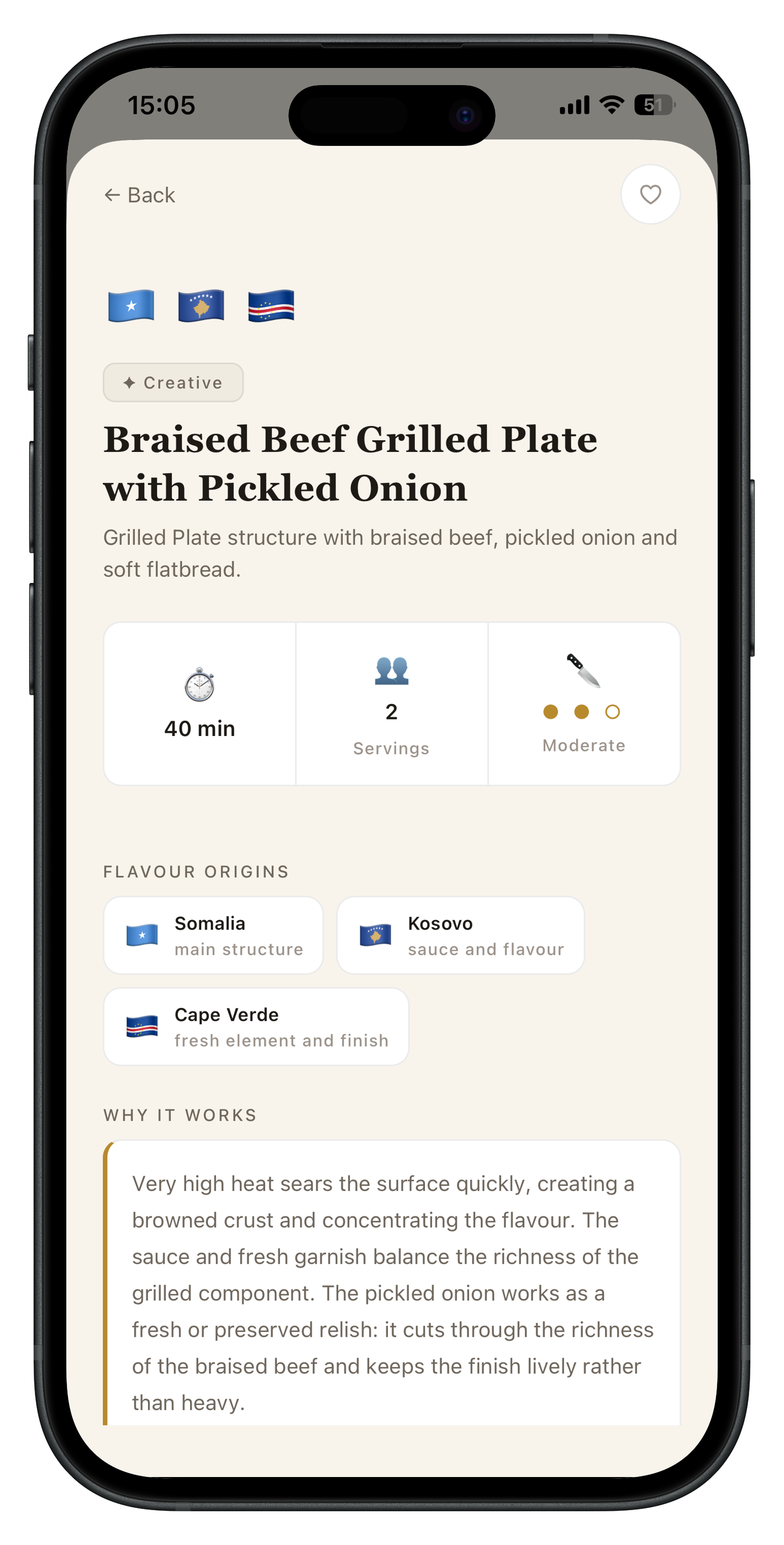
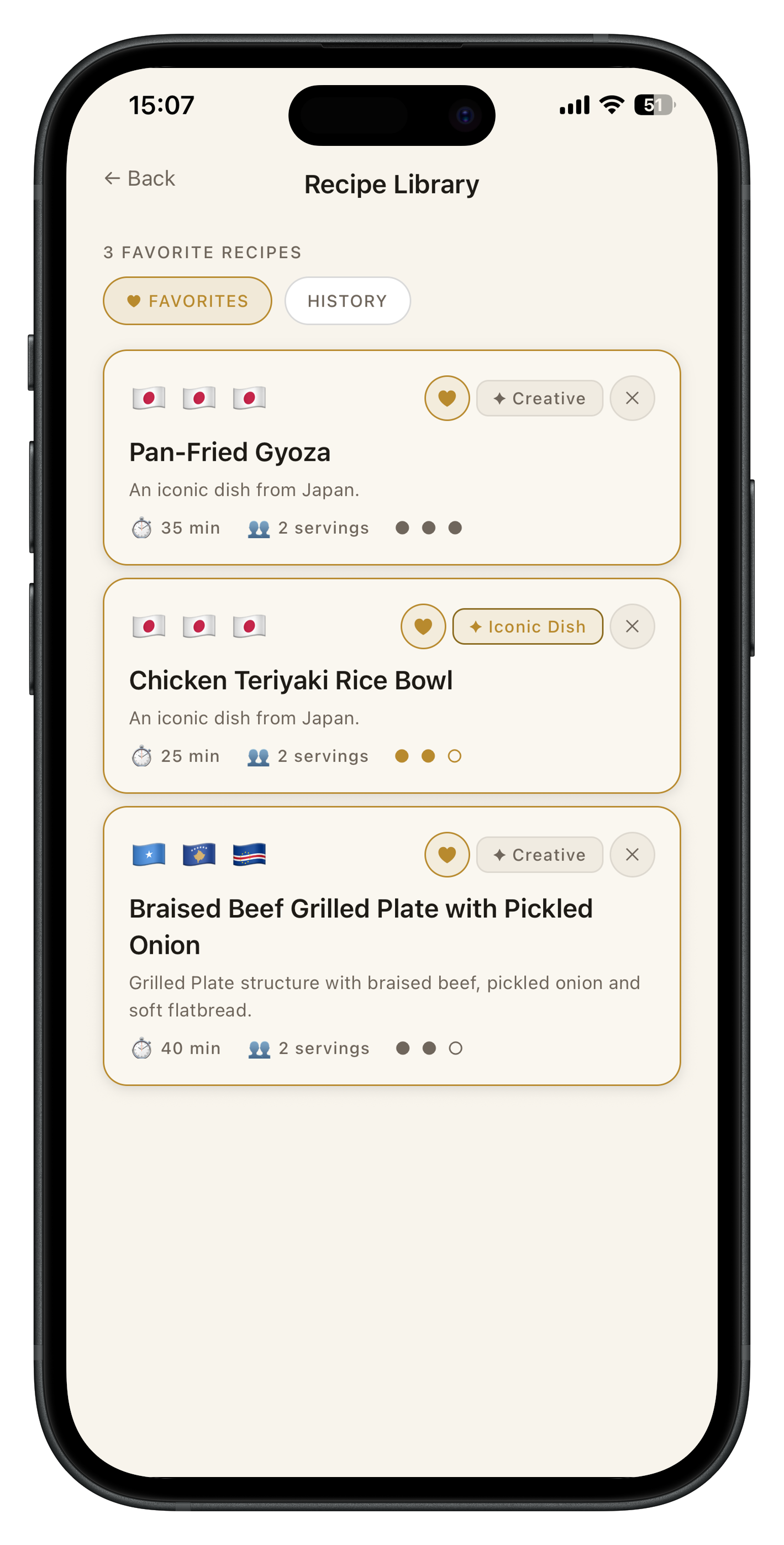
Land on three different countries, and the app treats it as a fusion. It pulls the main structure of the dish from one country, the sauce from a second, and a fresh finishing element from a third, then tags the result "Creative." One spin gave me a Braised Beef Grilled Plate with Pickled Onion: Somali structure, Kosovan sauce, a Cape Verdean pickled onion to finish. Each recipe detail page even breaks down why the combination works, since a fusion like that isn't something anyone's grandmother actually cooked, and it deserves an explanation, not just a claim of authenticity.
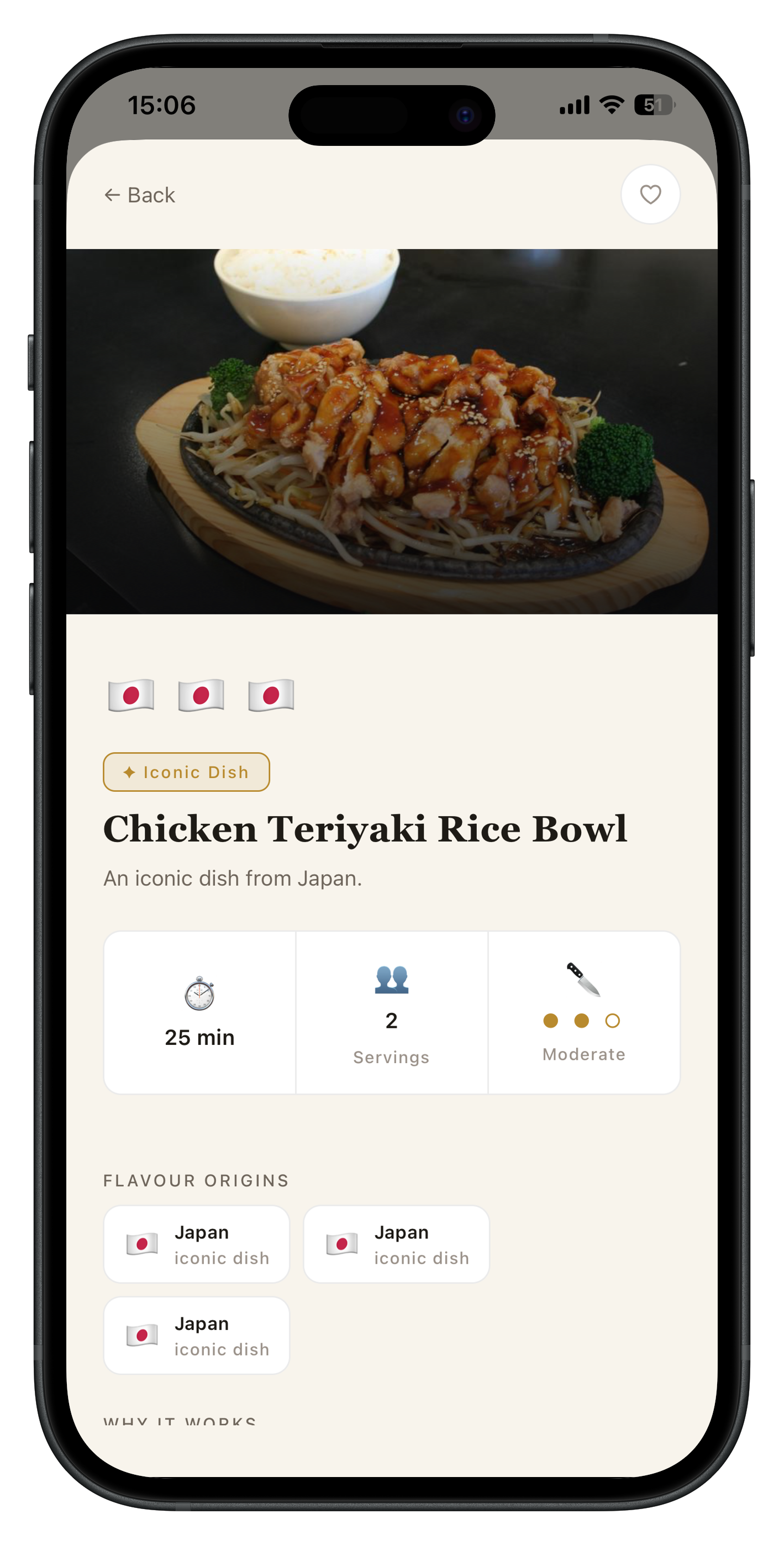
Land on the same country in all three slots, and the app switches modes entirely. Instead of a fusion, it surfaces that country's Iconic Dish, the single recipe most associated with the place, alongside a shortlist of other real, Classic dishes from the same kitchen. Spin into Japan three times and you might get a Chicken Teriyaki Rice Bowl marked as the Iconic Dish, with a Tonkotsu Ramen Bowl sitting right below it as a Classic alternative.
Iconic Dish pages get a bit more care than the fusions: a real photo of the finished plate, and a background story explaining where the name or technique comes from (teriyaki means "glazed grill" in Japanese, for what it's worth). That extra layer of story is part of what premium unlocks, alongside the deeper country library.
None of this existed in the first version. It came from building the "national dish" list I mentioned earlier and realizing that treating every country the same, one recipe, no distinction, flattened the exact thing that made spinning into your own country's food feel different from spinning into a random blend of three.
Everything After the Exciting Part
Collecting recipes that were actually good, and actually representative of a country, turned out to be its own project. It's easy to grab a "national dish" list off the internet; it's harder to make sure the recipe attached to each country feels real rather than like a stereotype. I spent a lot of time trying to balance authenticity with accessibility, a recipe that respects where it comes from, but that an ordinary home cook (like me) can actually finish without special equipment or an ingredient list that requires three specialty stores.
The spin animation went through more iterations than I'd like to admit. Too fast, and it feels like nothing. Too slow, and it feels like you're staring at a progress bar. I wanted that few-second window to carry the same tiny anticipation as watching a loot box crack open, minus anything that resembles gambling. It's a strange thing to spend hours tuning, an easing curve on a spinning globe, but that small moment of suspense is most of what makes the app feel different from just opening a recipe website.
Going Offline, On Purpose
Making everything work offline was a deliberate decision from the start, not an afterthought. I didn't want PassportPlate to depend on a live AI API to generate a recipe every time someone spins, both because that's fragile (no internet, no dinner) and because I didn't want a subscription-shaped cost sitting behind every single spin. So the app is self-contained: the recipes and country data live on the device, and the whole loop works with your phone in airplane mode.
That same instinct shaped the business model. I wanted premium to feel fair, not like a toll gate. There's no subscription. Premium unlocks more countries, deeper recipe discovery, favorites, and history, and removes ads, but the core experience, spin, get a country, cook a real meal, works completely for free.
Privacy Was Not Optional
Privacy mattered to me for the same reason. No account, no login, no cloud sync, no analytics quietly running in the background. You install it, you open it, it works. I don't need to know what you're cooking, and honestly, I don't want to.
Somewhere to Keep Them
Once people started spinning more than once a day, it became obvious that every result needed somewhere to live afterward. Every spin, Random or Custom, now lands in a Recipe Library: favorite the ones worth cooking again, and everything else still sits in a running history you can scroll back through or clear whenever you want.
What This Project Taught Me
If there's a lesson in building PassportPlate, it's that software doesn't need to solve a huge problem to be worth building. Choosing dinner sounds like the most trivial decision imaginable, and yet millions of people go through some version of that exact conversation every single evening. If an app can turn that moment from mildly frustrating into mildly fun, it's already made someone's day slightly better. That's a low bar, and I think that's the point.
Out of everything I've built, PassportPlate is probably the most personal. It didn't start from a market gap or a business plan. It started from a tired conversation in our kitchen and a half-joking suggestion about spinning a wheel. It's a good reminder that the best ideas rarely come from a brainstorm. They come from paying attention to the small, ordinary problems everyone has quietly agreed to just live with.
Where to Get It
PassportPlate is available on the App Store.
- App Store
- Read more on the PassportPlate project page.